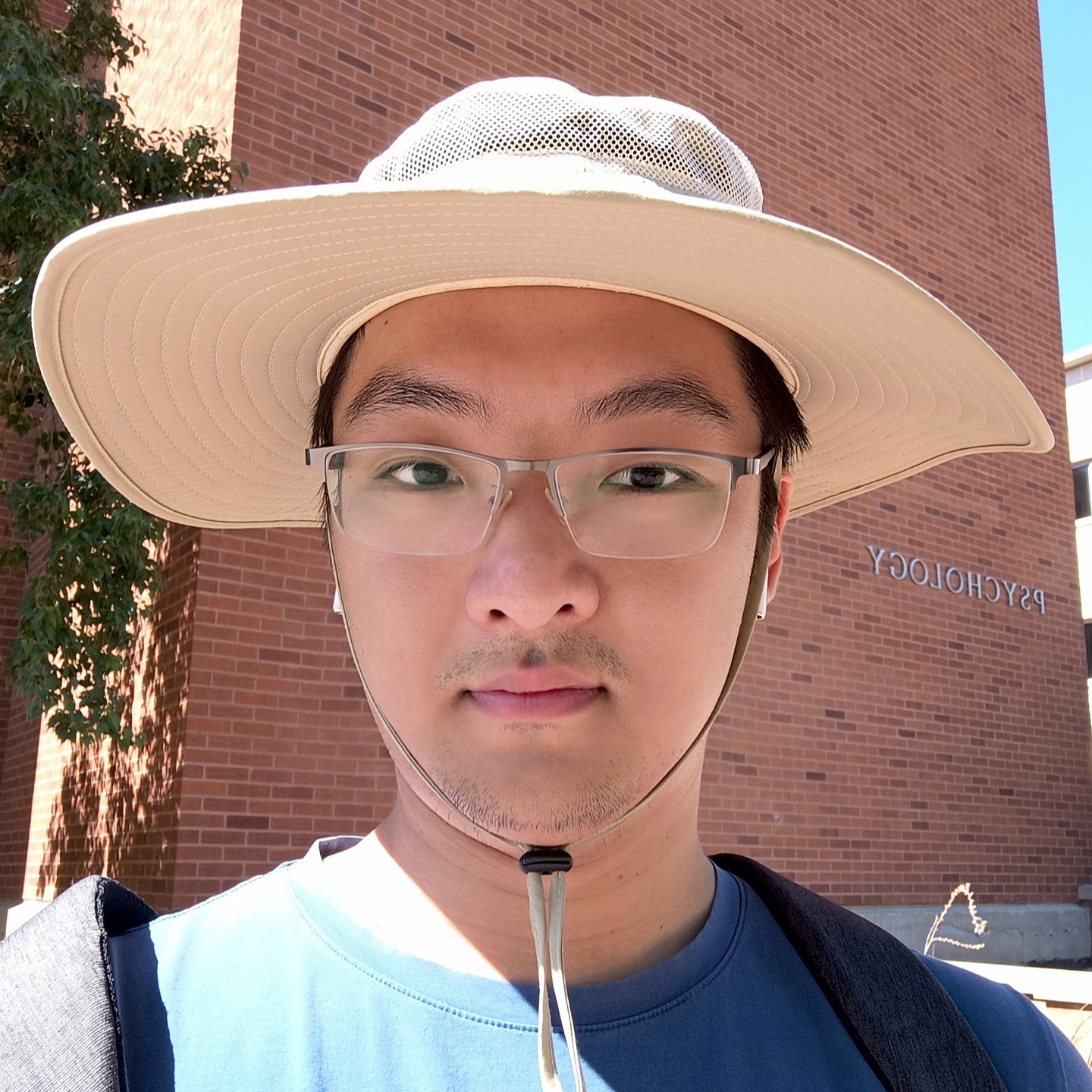
Hi! I am Huadong
My research asks how humans, AI, and scientific communities learn, and how the concepts and models they use shape what they can learn next. I am also interested in how the structure and limits of the human mind shape the knowledge we can develop and share. An explanation needs to fit what we observe, but it also needs to be simple enough for us to understand and use. I want to find levels of abstraction for understanding intelligence that explain behavior, connect findings across different tasks and systems, and work within these human constraints.
I am now a postdoc with James Evans at the University of Chicago, studying these questions in science. A research community’s shared concepts and methods guide which hypotheses it considers and which it overlooks. I study the biases humans and AI bring to this process: does AI mainly recombine ideas within the space humans have already explored, or can it expand that space in scientifically useful ways? My earlier finding that large language models (LLMs) can evaluate hypotheses better than they generate them in a controlled task motivates this question. I want to use this understanding to build AI systems that help scientists explore and test ideas they would otherwise miss.
I am looking for full-time Research Scientist positions in automated science and AI alignment. If you’re interested in collaborating, please feel free to email me.
During my PhD in Psychology at the Georgia Institute of Technology, advised by Robert Wilson, I asked a similar question about the concepts researchers use to explain human decisions. I used recurrent neural networks, with fewer assumptions about decision making, to examine what conventional models treat as noise and revise the vocabulary those models use. This led to an online learning perspective: people learn both about the world and how to change their learning strategies, with strategy changes resembling policy gradient ascent.
I also studied in-context learning in LLMs, where a model learns from a prompt without changing its trained weights. This let me examine how existing representations shape new learning and cause interference between memories. My PhD collaborations included Marcelo Mattar at NYU and Li Ji-An at UCSD, with part of my LLM work done with Xue-Xin Wei at UT Austin and Kwonjoon Lee at Honda Research Institute. More details are on my Projects page.
Before my PhD, I worked with Da-Hui Wang at Beijing Normal University, developing spiking neural network models to investigate the biophysical mechanisms of binding features across two dimensions in multi-item working memory. With Xue-Xin Wei, I developed a recurrent neural network model to investigate the neural mechanisms underlying how working memory represents prior distributions over stimuli. Earlier, I used EEG to study working memory and studied counseling psychology with a focus on cognitive behavioral therapy.
The pronunciation of my name is “HWAH-doang SHAWNG”.
Some of my writing
I also write about cognition, science, and the concepts we use to understand the world. If something interests you, feel free to email me. I’d like to hear what you think.
Some interesting facts:
- I enjoyed reading when I was young. My favorite writers are James Joyce, Milan Kundera, Jorge Borges, Franz Kafka, Dostoyevsky and Edgar Allan Poe.
- I chose this stupid username (sakimarquis) as a teenager. It came from Saki and Márquez.
- Yet I haven’t read much since high school. I suddenly lost my patience with long books.
- I am addicted to computer games, but only when an exam is approaching. Since I have few exams to take, I seldom play them now.
- I enjoy sick jokes and embarrassing short videos.
- Using a second language is painful for me, mostly because I can’t help being sarcastic but I can’t do it well in English.
- I am bad at calculating. I often mess up single-digit calculations, even with a pen and paper. This always makes me doubt myself as a researcher in computational neuroscience. (But large language models also fail at simple calculations, so I am not alone.)